

UAE Corporate Tax Registration: Step-by-Step Process, Deadlines & Penalties
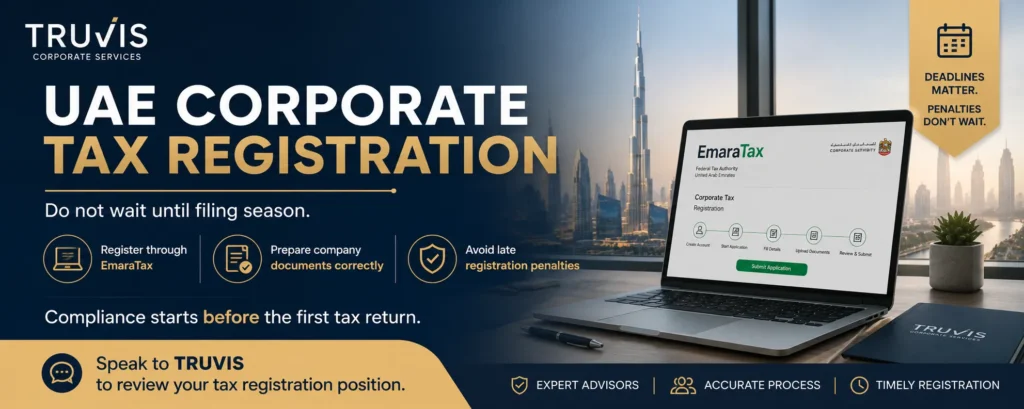
UAE corporate tax registration has become one of the most important compliance steps for businesses operating in the UAE.
For many founders, the confusion starts immediately after company formation. The trade licence is issued. The bank account process begins. The company may not yet be profitable. In some cases, the business may not even have started trading.
So the question becomes:
Do we still need to register for corporate tax?
In many cases, the answer is yes.
The UAE introduced federal corporate tax for financial years starting on or after 1 June 2023. Since then, companies have had to understand not only whether they owe tax, but whether they must register, maintain records, file returns, and meet Federal Tax Authority deadlines.
This is where many businesses make a costly mistake.
They assume corporate tax registration is only required once tax becomes payable. Others assume that because they are in a UAE free zone, registration is not necessary. Some wait until the first tax return deadline approaches before opening their EmaraTax account.
That approach can create penalties.
Corporate tax registration is not a year-end task. It is an early compliance obligation that should be handled as part of the company’s post-formation setup, alongside accounting records, UBO records, VAT threshold monitoring, banking readiness, and licence renewal planning.
This guide explains how UAE corporate tax registration works, who needs to register, what documents are required, how the EmaraTax process works, what common mistakes delay applications, and why missing the applicable deadline can create an AED 10,000 administrative penalty.
What Is UAE Corporate Tax Registration?
UAE corporate tax registration is the process of registering a taxable person with the Federal Tax Authority, commonly known as the FTA, for corporate tax purposes.
Once registration is approved, the company receives a Tax Registration Number, often referred to as a TRN.
The TRN is the company’s official tax identification number for corporate tax. It is used for future filing, correspondence, tax return submission, and compliance tracking through the FTA’s EmaraTax portal.
Registration does not always mean that the company will immediately pay corporate tax.
This is an important distinction.
A business may need to register even if its taxable income is below the taxable threshold. A free zone company may need to register even if it expects to qualify for 0% tax on qualifying income. A newly formed company may need to register before it has filed its first return.
The purpose of registration is to place the company within the UAE corporate tax compliance system.
The amount of tax payable, if any, is a separate question determined by taxable income, entity type, free zone status, available reliefs, and applicable corporate tax rules.
Who Needs to Register for Corporate Tax in the UAE?
In general, UAE companies that fall within the scope of corporate tax need to register with the FTA.
This includes many mainland companies, free zone companies, and other juridical persons incorporated or registered in the UAE.
The FTA has also clarified that taxable persons must submit corporate tax registration applications within specified timelines, and failure to comply can result in an administrative penalty of AED 10,000. (FTA UAE)
Corporate tax registration may apply to:
- Mainland LLCs
- Free zone companies
- UAE branches of foreign companies
- Certain exempt persons required to register
- Natural persons conducting business activity in the UAE above the relevant turnover threshold
- Other entities falling within the UAE corporate tax framework
Natural persons are treated differently from companies. The FTA has stated that a natural person conducting a business or business activity in the UAE is generally required to register if total turnover exceeds AED 1 million in a calendar year. The FTA also noted that failing to register by the applicable deadline can result in an AED 10,000 penalty. (FTA UAE)
For companies, the exact registration timeline depends on the applicable FTA registration rules, licence issuance date, incorporation status, and category of taxable person.
This is why every company should check its registration position early rather than waiting until the first tax return is due.
Do Free Zone Companies Need Corporate Tax Registration?
Yes, many UAE free zone companies still need to register for corporate tax.
This is one of the most common misunderstandings in the UAE market.
A free zone licence does not automatically mean the company is outside the corporate tax system. Free zone companies may be eligible for 0% corporate tax on qualifying income if they meet the conditions of the Qualifying Free Zone Person framework. But that does not remove the need to understand registration, filing, substance, accounting, and documentation obligations.
The TRUVIS corporate tax guidance highlights that free zone companies can access 0% tax treatment only if they meet the relevant QFZP conditions, and business owners should not assume free zone status alone protects them automatically.
In practical terms, a free zone company should ask:
- Has the company registered with the FTA?
- Does it have a corporate tax TRN?
- Does it meet QFZP conditions?
- Is its income qualifying or non-qualifying?
- Does it maintain adequate substance?
- Are accounting records properly maintained?
- Is there a filing calendar in place?
The registration step is only the beginning. The company’s tax position must still be reviewed properly.
What Is EmaraTax?
EmaraTax is the Federal Tax Authority’s online tax platform.
Corporate tax registration is completed through EmaraTax. Businesses use the platform to create or access an account, submit registration information, upload supporting documents, respond to FTA requests, and receive the corporate tax TRN once approved.
The FTA has also referred to EmaraTax in relation to corporate tax registration applications and tax return submission, including late registration penalty waiver conditions. (FTA UAE)
For many business owners, the process appears simple on the surface. The challenge is not usually opening the portal. The challenge is submitting correct and consistent information.
If licence details, shareholder documents, authorised signatory information, or entity classification are incorrect, the application may be delayed or returned for clarification.
Documents Required for UAE Corporate Tax Registration
The exact document requirements can vary depending on the company type, ownership structure, and FTA request.
However, most UAE companies should be ready with the following:
- Trade licence
The company’s valid UAE trade licence is usually required. The licence details must match the entity information being submitted. - Certificate of incorporation or registration
Free zone companies and certain entity types may need to provide incorporation documents or registration certificates. - Memorandum of Association or Articles
The company’s constitutional documents may be required to confirm ownership, structure, and authorised powers. - Shareholder details
The FTA may require shareholder information, especially where ownership structure is relevant to the registration profile. - Passport copies
Passport copies of shareholders, managers, directors, or authorised signatories may be required. - Emirates ID copies
Where applicable, Emirates ID copies should be available for UAE residents linked to the company. - Authorised signatory information
The person submitting or managing the tax registration must be properly authorised. - Contact details
Email, phone number, and address information should be accurate because the FTA may use these for official communication. - Business activity information
The company should describe its actual business activity clearly and consistently with the trade licence and operating model. - Financial year details
The company must confirm its financial year, which affects tax period and filing deadlines.
The safest approach is to review the company file before submission. Inconsistent documents are one of the most common causes of delay.
Step-by-Step Corporate Tax Registration Process
Step 1: Review Whether the Company Must Register
Before starting the application, confirm whether the company falls within the UAE corporate tax registration scope.
This should include a review of:
- Entity type
- Licence date
- Jurisdiction
- Free zone or mainland status
- Business activity
- Natural person vs juridical person status
- Applicable FTA deadline
Do not assume that no tax payable means no registration required.
Step 2: Prepare the Company Documents
Collect all required documents before starting the EmaraTax application.
This avoids incomplete submissions and reduces the chance of FTA queries.
Make sure the trade licence is valid, shareholder information is updated, and authorised signatory documents are consistent with company records.
Step 3: Create or Access the EmaraTax Account
The company or authorised person must access the EmaraTax portal.
If the company already has a VAT account, it may already have access to EmaraTax. If not, a new account may need to be created.
The account should be linked to the correct taxable person.
Step 4: Start the Corporate Tax Registration Application
Inside EmaraTax, select corporate tax registration and begin the application.
The portal will ask for details such as:
- Entity name
- Licence details
- Legal form
- Incorporation information
- Business activity
- Contact details
- Financial year
- Ownership and authorised signatory details
Accuracy matters. Incorrect entity type or mismatched licence information can delay approval.
Step 5: Upload Supporting Documents
Upload the required documents in the correct format.
Files should be clear, valid, and current. Expired licences, unclear passport scans, or inconsistent names may cause the application to be sent back.
For complex structures, supporting documents should clearly explain ownership and control.
Step 6: Review Before Submission
Before submitting, review every field carefully.
Check spelling, licence number, issue date, expiry date, shareholder details, contact email, and authorised signatory information.
A small error can become a long delay.
Step 7: Submit the Application to the FTA
Once submitted, the FTA will review the application.
The FTA may approve it or request additional information. If a request is received, respond quickly and accurately.
Step 8: Receive the Corporate Tax TRN
Once approved, the company receives its corporate tax TRN.
This number should be saved in the company’s compliance records and shared with the accounting or tax team responsible for future filings.
Corporate Tax Registration Deadlines
Corporate tax registration deadlines depend on the taxable person category and applicable FTA rules.
The FTA has issued public clarifications and reminders on registration timelines, including licence-month based deadlines for resident juridical persons and deadlines for natural persons exceeding the relevant turnover threshold. The FTA has also confirmed that missing the applicable registration timeline can result in an AED 10,000 administrative penalty. (FTA UAE)
For this reason, businesses should not rely on general assumptions.
A company should identify:
- Its licence issue date
- Its incorporation date
- Its first financial year
- Whether it is a juridical or natural person
- Whether it is resident or non-resident for corporate tax purposes
- Whether any exempt person registration rules apply
Once these are known, the applicable registration deadline can be mapped.
Penalties for Late Corporate Tax Registration
The key penalty business owners should know is the AED 10,000 administrative penalty for failing to submit a corporate tax registration application within the specified deadline. The FTA has repeatedly referenced this penalty in public guidance and reminders. (FTA UAE)
There has also been a late registration penalty waiver initiative. The FTA has stated that, to qualify for waiver of the late corporate tax registration penalty, the taxable person must submit the tax return within seven months from the end of the first tax period. The FTA also notes that relevant registration applications and tax returns or annual declarations should be submitted via EmaraTax. (FTA UAE)
However, companies should not rely on waiver relief as a planning strategy.
The better approach is simple:
Register correctly.
Register early.
Maintain the filing calendar.
Avoid the penalty issue completely.
Common Mistakes That Delay Registration
Many corporate tax registration delays are avoidable.
The most common mistakes include:
- Waiting too long
Business owners assume registration can be handled close to the filing deadline. In reality, the registration deadline may be earlier. - Assuming free zone companies are exempt
Free zone companies may still need to register and file, even where 0% treatment may apply. - Using incorrect entity type
Selecting the wrong legal form can cause processing issues. - Uploading expired documents
Expired trade licences or outdated company documents can delay approval. - Mismatch between licence and application details
Company name, licence number, issue date, or activity details must be consistent. - Weak ownership information
If shareholder or UBO records are unclear, the application may require further review. - No accounting system in place
Registration is only the start. The company also needs records to support future tax return filing. - Ignoring future filing obligations
Receiving the TRN does not complete the corporate tax obligation. The company must still maintain records and file returns.
Why Corporate Tax Registration Should Be Done Early
Early registration gives the company control.
It allows the business owner to identify issues before deadlines approach, update documents, organise accounting records, and understand whether QFZP, small business relief, tax group, or other planning considerations may apply.
Late registration creates pressure.
The company may need to collect documents quickly, respond to FTA queries, correct licence details, and manage penalty exposure at the same time.
For founders, investors, and SMEs, corporate tax registration should be treated as part of the company’s operating foundation.
A company is not fully compliance-ready just because the licence has been issued.
It must also be tax-registered where required, properly documented, and ready for future filing.
How TRUVIS Supports UAE Corporate Tax Registration
TRUVIS supports UAE companies with corporate tax registration and post-formation compliance planning.
This includes:
- Reviewing whether the company needs to register
- Preparing the EmaraTax registration file
- Checking trade licence and shareholder documents
- Reviewing free zone or mainland status
- Supporting document upload and application submission
- Following up on FTA queries
- Confirming TRN issuance
- Coordinating with accounting and tax filing requirements
- Helping founders understand QFZP and corporate tax exposure
The objective is not only to submit an application.
The objective is to make sure the company’s tax position is understood, documented, and managed properly from the start.
Conclusion
UAE corporate tax registration is now a core compliance requirement for businesses operating in the UAE.
It should not be delayed until filing season. It should not be ignored because the company is in a free zone. And it should not be treated as a simple portal form without reviewing the company’s documents, ownership, financial year, and tax position.
A missed registration deadline can create an AED 10,000 penalty. More importantly, it can signal that the company’s compliance calendar is not being managed properly.
For UAE companies, the right approach is clear:
Register through EmaraTax on time.
Keep company documents accurate.
Understand the tax position early.
Maintain accounting records from the beginning.
Prepare for filing before the deadline arrives.
Corporate tax compliance starts before the first tax return.
Need help with UAE corporate tax registration? TRUVIS supports UAE companies with EmaraTax registration, FTA document review, TRN follow-up, and corporate tax compliance coordination. Speak to TRUVIS before a missed registration deadline becomes a penalty issue.
Related TRUVIS services
- Uae corporate tax and accounting services — corporate tax filing, VAT and bookkeeping handled by TRUVIS.
- Entity management and corporate governance — registered agent, filings and ongoing compliance.
- TRUVIS Jurisdiction Decision Hub — a structured comparison of where to establish, since the jurisdiction you pick determines which tax treatment applies to you at all.
