
ADGM vs DIFC in 2026: Choosing the Right UAE Financial Free Zone
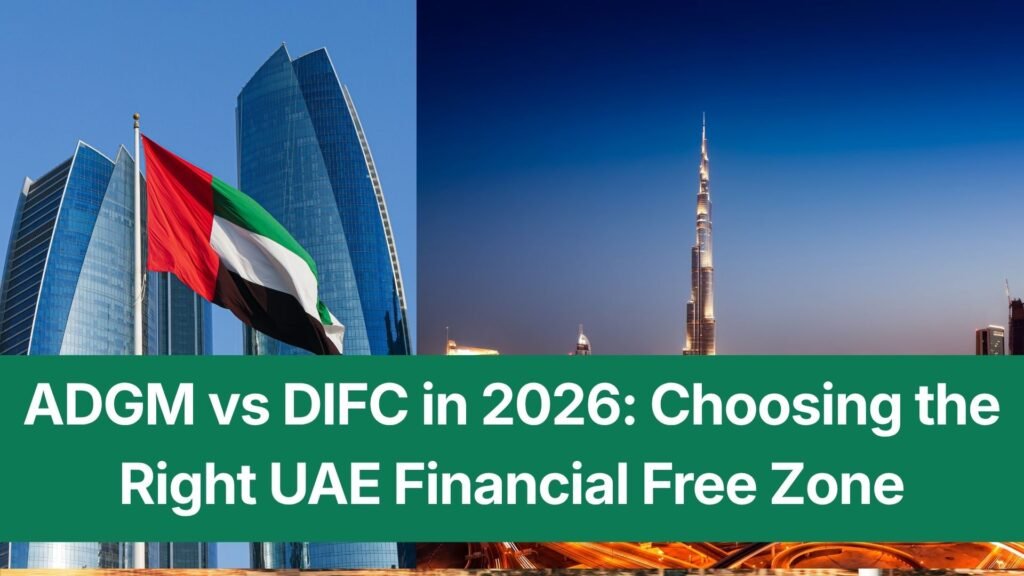
The choice of ADGM vs DIFC is one of the most consequential early decisions for any financial, fintech, fund or holding business entering the UAE. Both are common-law financial free zones with independent regulators and English-language courts, and both confer the credibility international banks, investors and counterparties look for. Yet they suit different strategies, cost profiles and growth paths. This 2026 guide breaks down how the two compare and gives you a practical way to decide.
ADGM and DIFC: what they share
Abu Dhabi Global Market (ADGM) and the Dubai International Financial Centre (DIFC) are the UAE’s two financial free zones, and at a structural level they have a great deal in common. Understanding the shared foundation first makes the genuine differences easier to weigh.
- Common-law framework — each operates its own civil and commercial laws based directly on English common law, rather than onshore UAE civil law.
- Independent courts — both run English-language common-law courts with experienced international judges, separate from the onshore court system.
- Independent financial regulator — the Financial Services Regulatory Authority (FSRA) in ADGM and the Dubai Financial Services Authority (DFSA) in DIFC, each authorising and supervising regulated firms.
- 100% foreign ownership and no restriction on repatriation of capital or profits.
- Recognised, bankable status — global banks, fund administrators and law firms understand both zones, which eases account opening, fundraising and contracting.
Because the foundation is so similar, the decision rarely turns on legal credibility. It turns on ecosystem fit, the specific regulated activity, the cost of being correctly licensed, and where your team and clients actually sit.
ADGM vs DIFC: where they genuinely differ
DIFC is the older and larger hub, with a deep, mature cluster of global banks, asset managers, insurers and professional-services firms concentrated in the heart of Dubai. Firms that value an existing ecosystem, brand prestige and proximity to Dubai’s commercial market often gravitate to it.
ADGM, based in Abu Dhabi, has grown quickly as a more agile, often more cost-competitive alternative. It is known for a strong fintech and innovation proposition, a regulatory sandbox (RegLab), and a flexible structuring toolkit that includes special purpose vehicles (SPVs) and foundations widely used for holding and wealth-structuring purposes.
In practice the contrast usually comes down to a few dimensions:
- Ecosystem depth vs agility — DIFC’s established network against ADGM’s speed and flexibility.
- Location — Dubai’s commercial gravity (DIFC) versus Abu Dhabi’s institutional and sovereign-capital environment (ADGM).
- Structuring tools — ADGM’s SPV and foundation regimes are popular for holding and family-office work.
- Innovation pathways — both support fintech, but each has its own sandbox and tailored regimes; the right fit depends on your activity.
Matching the zone to your business model
The cleanest way to narrow the ADGM vs DIFC question is to start from what you actually do, not from headline branding. The following patterns are common starting points — your specific activity and regulatory permissions should always be confirmed before you commit.
- Fund management and global asset managers — DIFC’s ecosystem, fund regime and recognition often make it the natural home, particularly where you want to be close to a large investor and service-provider community.
- Fintech, digital assets and sandbox-stage firms — ADGM is frequently the more agile and affordable route, with a well-regarded innovation and RegLab proposition.
- Holding companies, SPVs and foundations — ADGM’s structuring toolkit is widely used for holding structures, asset protection and succession planning.
- Wealth management and private banking — both work; the decision tends to follow where your clients, bankers and intermediaries are concentrated.
- Proximity to Dubai’s commercial market — if your clients, partners and lifestyle sit in Dubai, DIFC’s central location carries real day-to-day weight.
If your activity is not a regulated financial-services activity at all, it is worth checking whether a financial free zone is even the right vehicle — a mainland or another free-zone licence may be simpler and cheaper. That triage matters as much as the ADGM-versus-DIFC comparison itself.
Costs, capital and timelines: comparing honestly
Setup and ongoing costs vary by regulated activity, substance requirements, headcount and office footprint, so headline price comparisons can mislead. A figure that looks low on a brochure may exclude regulatory capital, compliance staffing or office space that your specific permission requires.
Minimum capital, application fees, annual fees and substance expectations all vary by category and activity — confirm current requirements with the relevant regulator before budgeting. The more useful exercise is to compare the total cost of being correctly licensed and operational in each zone, not a single line item. That total typically includes:
- Regulatory capital appropriate to your category and risk profile.
- Application and annual regulatory and registration fees.
- Physical office or flexible-desk space meeting substance expectations.
- Compliance, governance and key-function staffing (for regulated firms).
- Ongoing reporting, audit and professional-services costs.
Timelines likewise depend on activity, the completeness of your application and how quickly you can evidence substance and key personnel. Treat any single quoted timeframe as indicative and category-dependent rather than a guarantee.
A practical decision framework
If you want a structured way to choose, work through these questions in order before you weigh cost:
- What is the precise regulated activity? Confirm it is permitted and how each regulator classifies it — this drives capital, fees and timeline more than anything else.
- Where are your clients, capital and team? Proximity to your investor base and key hires is often decisive.
- Do you need a structuring vehicle (SPV or foundation)? If holding, succession or asset protection is central, ADGM’s toolkit is worth examining closely.
- How important is ecosystem and brand? Established networks can shorten fundraising and hiring; weigh that against cost and agility.
- What is the realistic total cost over the first few years? Model capital, fees, office, staffing and compliance together, not in isolation.
Score each zone against these questions for your specific case. In most situations a clear leader emerges — and where it does not, the tie usually breaks on location and ecosystem rather than on the legal framework, which is broadly comparable.
How TRUVIS helps you decide
TRUVIS maps your activity, capital position and growth plan against both regulators, then recommends the jurisdiction that genuinely fits — and manages the structuring and application end to end so you are not navigating two rulebooks alone. Rather than starting from a marketing preference, we start from your regulated activity and total cost of being operational. Start with our Jurisdiction Decision Hub to get a tailored, side-by-side view for your business.
Frequently asked questions
Is ADGM cheaper than DIFC?
ADGM is often positioned as the more cost-competitive option, but a meaningful comparison depends on your specific activity, capital category, substance and office needs. Costs vary by category and activity, so the only reliable answer comes from modelling the full cost of being correctly licensed in each zone for your model and confirming current requirements with the regulator.
Which is better for fintech, ADGM or DIFC?
Both actively support fintech and each offers an innovation pathway and sandbox. ADGM’s RegLab and agility make it a frequent choice for early-stage and digital-asset firms, while DIFC’s depth suits firms that want to sit close to a large financial ecosystem. The better fit depends on your exact activity and where your clients and capital are — neither is universally superior.
Can I move my licence from one zone to the other later?
Relocating or re-licensing between zones is possible in principle but is effectively a fresh authorisation, with its own application, capital and substance requirements, and it is rarely costless or instant. Choosing the right zone at the outset is far more efficient than migrating later, which is why a careful upfront assessment is worth the effort.
TRUVIS provides strategy-led advisory and managed business services; we are not a broker. The information above is general and indicative, may change with regulatory updates, and is not legal, tax or financial advice. Capital, fees, timelines and eligibility vary by category and activity and must be confirmed with the relevant authority. Approvals for licences, visas, banking, Ejari or Tawtheeq are never guaranteed and remain subject to the relevant authority. Speak to our team for guidance tailored to your case.