

Mainland, Free Zone, ADGM or DIFC: A Structured Way to Choose Your UAE Jurisdiction
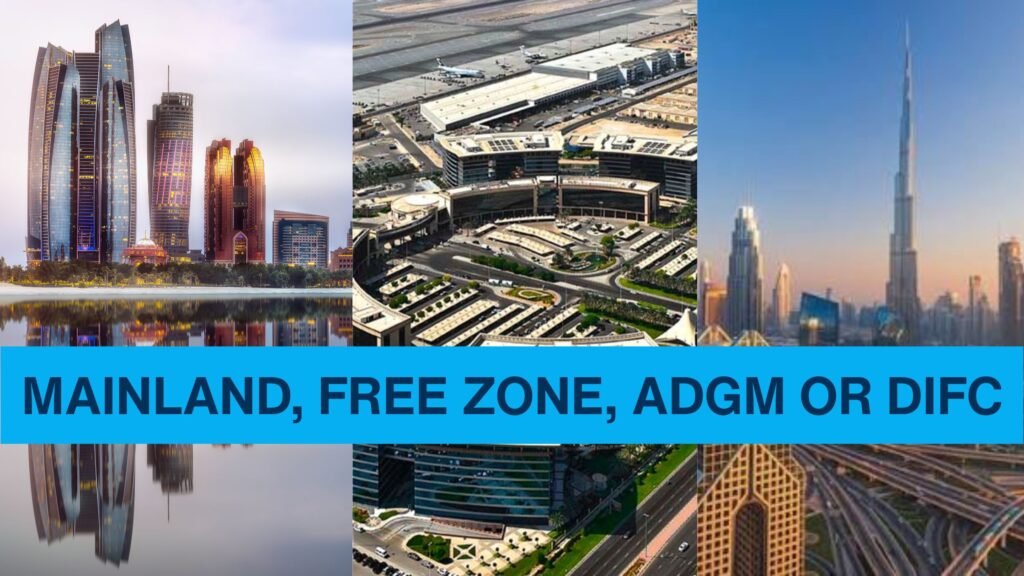
“Which free zone is cheapest?” is the most expensive question in UAE company formation.
The licence fee is the smallest number in the jurisdiction decision. The larger numbers arrive later: the bank that declines an application because the activity is unclear; the 9% corporate tax rate that applies because QFZP conditions were never designed into the structure; the restructuring bill when your lead investor requires legal architecture your zone cannot provide.
With more than 45 free zones, two common-law financial centres and mainland licensing in all seven emirates, the UAE does not have an options problem. It has a selection problem — and price lists do not solve it.
The five inputs that actually decide it
— Commercial model and customer location. If your customers are in the UAE consumers, onshore businesses, government — mainland market access matters and points the analysis one way. If your revenue is international, the free zones open, and the question becomes which one.
— Tax position. The 0% Qualifying Free Zone Person rate is a set of conditions qualifying income, substance, audited accounts, de minimis limits — that must be designed in from day one, not claimed at filing. Small Business Relief, the standard 9% and the interaction with your home-country rules complete the picture.
— Banking profile. Institutions have measurably different track records by zone, activity and nationality profile. A jurisdiction that your realistic banking options do not support is not a viable jurisdiction, whatever it costs.
— Legal architecture. If your investors require preference shares, an ESOP, SAFE notes or a drag-along that actually works, you need English common law which points to ADGM or DIFC, not a commercial free zone constitution.
— Operating reality. Substance requirements, visa quotas, office obligations and renewal costs mean the true comparison is the two-year total cost of the structure, not the year-one licence price.
Three mismatches we correct most often
The e-commerce founder on a freelance permit who needs a payment gateway, corporate banking and VAT invoicing requirements the permit was never built for, so the “cheap” route gets bought twice.
The holding company placed in a commercial free zone that cannot express the share classes and investor protections the cap table requires — discovered during the funding round, at the worst possible moment.
And the consultant paying mainland costs for onshore market access their entirely-international client base never uses.
How to work through it properly
The sequence is assessment first, recommendation second.
We built a free, structured version of the first step: the TRUVIS Hub assessment at hub.truvis.ae works through exactly these inputs — comparing ADGM, DIFC and UAE mainland against your business in a few minutes, and producing a starting position a real advisory conversation can build on.
It is an assessment tool, not a mailing-list trap.
For the full decision including the free zone shortlist, the banking strategy, the tax position and the two-year cost model every TRUVIS engagement produces a written recommendation with the rationale attached: jurisdiction, entity type, licence activity scope, banking route, compliance obligations from day one, and the total cost across years one and two.
It is designed to be shown to your lawyer and your accountant, and to withstand their scrutiny.
That is the standard the decision deserves.
Start with the free structured assessment at hub.truvis.ae or book a consultation at truvis.ae to work through the full decision with an advisor.
General information, not tax or legal advice. Approvals, waivers and account openings are decisions of the relevant authorities and institutions.
