
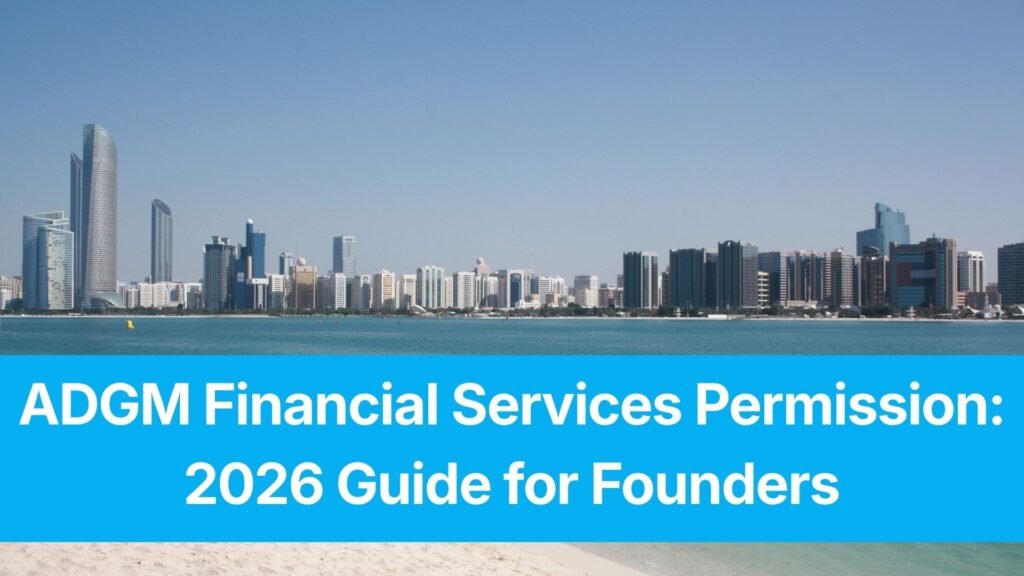
ADGM Financial Services Permission: 2026 Guide for Founders
If your firm intends to carry out a regulated financial activity in Abu Dhabi Global Market, you will need an ADGM Financial Services Permission (FSP) issued by the Financial Services Regulatory Authority (FSRA). This 2026 guide explains how ADGM authorisation actually works, the choices that shape your application, and how founders and CFOs can prepare an application that the regulator can move on with confidence.
What an ADGM Financial Services Permission authorises
The FSP is the FSRA’s formal authorisation to conduct one or more regulated activities. Those activities can include advising on investments, arranging deals, dealing as principal or agent, managing assets or a collective investment fund, providing custody, and operating payment or money services. Crucially, your permitted activities, conditions, and prudential requirements are written onto the permission itself. The permission is not generic — it is scoped to exactly what you do.
This is why scoping is the foundation of the whole exercise. Two firms in the same sector can hold very different permissions because their activities, client types, and risk profiles differ. Over-scope, and you inherit heavier capital, governance, and reporting obligations you do not need. Under-scope, and you may find a core part of your model sits outside what you are permitted to do.
Prudential categories and what scales with them
The FSRA places authorised firms into a prudential category framework. Your category is driven by the regulated activities you carry on and the risk they present — for example, whether you hold or control client assets, deal as principal, or run a fund. Several obligations scale with that category rather than being fixed across the board:
- Base and risk-based capital — the minimum financial resources you must hold. Exact figures vary by category and activity; confirm current FSRA requirements before you model your runway.
- Regulatory reporting — the frequency and depth of returns you submit.
- Systems and controls — the proportionality of your risk, compliance, and operational frameworks.
- Professional indemnity insurance — where it applies to your activity set.
The practical takeaway for a CFO: decide the category you are aiming for early, because it changes your capital plan, your hiring, and your cost base. Treat it as a design decision, not an afterthought.
Controlled functions and the people the regulator assesses
The FSRA authorises firms, but it also approves the individuals who run and control them. A credible application names real, qualified people for the key controlled functions, including roles such as:
- Senior Executive Officer — accountable for the firm’s day-to-day conduct and resident in the UAE.
- Compliance Officer — owns the compliance framework and the relationship with the regulator.
- Money Laundering Reporting Officer (MLRO) — responsible for AML/CFT oversight and suspicious activity reporting.
- Finance Officer — responsible for financial resources and regulatory reporting.
The FSRA tests these individuals for fitness and propriety: relevant experience, integrity, and the capacity to actually perform the role. A common reason applications stall is naming placeholders or spreading one person too thinly across functions that the regulator expects to be properly resourced.
The document set behind a strong application
An ADGM Financial Services Permission application is evidence-led. The regulator wants to see that you have thought your business through, not just described it. Expect to prepare and align the following:
- A regulatory business plan that clearly states the regulated activities, target clients, and how the model works.
- A financial model with realistic projections, capital adequacy, and stress scenarios that match the plan.
- A compliance manual and a risk management framework proportionate to your activities.
- AML/CFT policies and procedures, including customer due diligence and sanctions screening.
- Governance, outsourcing, and conduct policies showing clear accountability and oversight.
The single biggest quality signal is internal consistency. Your activities, your category, your capital, your people, and your policies should all tell the same story. When the financial model contradicts the business plan, or the compliance manual covers activities you are not requesting, the regulator asks more questions and the timeline lengthens.
Full FSP or the RegLab sandbox?
ADGM’s RegLab is a regulatory sandbox that lets innovative firms test a product under a tailored, time-limited authorisation with proportionate requirements before committing to a full FSP. It is a popular on-ramp for fintech founders who need to validate a model with real customers first. Use these criteria to decide:
- Choose RegLab when your proposition is genuinely novel, you want to prove demand and unit economics before scaling obligations, and you can operate within a controlled, limited scope.
- Go straight to a full FSP when your model is established, you already have the capital and senior team in place, and you need an unrestricted permission to win clients or partners from day one.
RegLab is a stepping stone, not a shortcut around authorisation — firms still graduate into a full FSP to scale. Plan for that transition rather than treating the sandbox as the destination.
The application journey, stage by stage
It helps to think of authorisation as a process rather than a single filing. In broad terms:
- Pre-application engagement — early dialogue with the FSRA to pressure-test scope and feasibility before you commit.
- Formal application — submission of the business plan, financial model, policies, and controlled-function applications.
- Review and clarification — the regulator’s assessment, typically with rounds of questions; responsiveness here directly affects pace.
- In-principle approval and conditions — confirmation subject to you meeting specified conditions, such as funding the capital or finalising office substance.
- Final permission — the FSP is granted and you can begin regulated activity within its scope.
Timelines vary by category, complexity, and how complete your submission is — confirm current expectations rather than assuming a fixed duration. The firms that move fastest are the ones that arrive with a coherent file and answer queries quickly.
How TRUVIS helps
TRUVIS scopes your ADGM Financial Services Permission, prepares the regulatory business plan and full policy suite, helps you line up controlled-function holders, and supports the FSRA application end to end — including the RegLab route where it fits your stage. Begin at licensing.truvis.ae. For the systems a permission eventually has to be backed by, see technology for finance and FinTech.
Frequently asked questions
How much capital do I need for an ADGM FSP?
It varies by prudential category and the specific activities you carry on — particularly whether you hold client assets or deal as principal. There is typically a base requirement and a risk-based element layered on top. Treat any figure as indicative and confirm current FSRA requirements before finalising your capital plan.
How long does FSRA authorisation take?
There is no fixed timeline. The pace depends on your category, the complexity of your model, and above all the completeness of your submission and how quickly you answer the regulator’s questions. A coherent, well-evidenced file moves faster than one the FSRA has to repeatedly clarify.
Is the RegLab sandbox a permanent licence?
No. RegLab is a time-limited, restricted authorisation designed for testing an innovative proposition. Firms that succeed in the sandbox typically transition into a full FSP to operate and scale, so it is best planned as a stage in your authorisation journey rather than an end state.
TRUVIS provides strategy-led advisory and managed business services; we are not a broker. The information above is general and indicative, may change with regulatory updates, and is not legal, tax or financial advice. Approvals for licences, visas, banking, Ejari or Tawtheeq are never guaranteed and remain subject to the relevant authority. Speak to our team for guidance tailored to your case.